
Placer County Criminal Court Cases
The Placer Superior Court Criminal Division handles felonies, misdemeanors, infractions, criminal appeals, domestic violence matters, and record-cleaning requests. Once a prosecutor files charges, the clerk creates a case number and register of actions. That court record can show what was actually alleged in court, which may differ from the charge written at arrest. It can also show a plea, trial result, dismissal, sentence, or later order.
Most Placer County criminal court records begin at the Hon. Howard G. Gibson Courthouse in Roseville. In-custody proceedings may occur in Department 20 at the jail courtroom. Auburn and Tahoe City remain part of the county court network, so location and department matter when checking an event. A court case does not include every sheriff report, unfiled arrest, or statewide fingerprint event. Those remain with their own custodians.
Placer Criminal Case Numbers
Placer eCourt gives criminal files a useful local marker: case numbers normally begin with 62 and continue with seven digits, such as 62-0000001. Civil and family matters use other prefixes. A 62 number is therefore a faster and more exact search key than a common name, though it does not by itself tell the reader whether the case is open or how it ended.
A criminal case number identifies a court file. It is not a sheriff booking number, California DOJ identifier, or proof of conviction.
Use the full number and punctuation shown by the court. When only a name is known, compare the filing date and public case details before treating a result as the intended Placer County court record.
Search Placer County Case Records
The court's Online Case Access page routes readers to eCourt Public. A case number is best. Name searching also works, but the filed-date control can hide a valid result when its range does not include the actual filing date.
- Open eCourt Public and choose a case-number or party-name search.
- Enter the full 62-prefixed number when known. Otherwise use the last name with a first name or initial.
- Set a broad filed-date range, then narrow it after the correct Placer County criminal case appears.
- Review the case type, status, hearings, department, register entries, and document indicators.
- Request a copy from the Criminal Division when a public document is absent online.
The available controls make it easy to refine a broad result:
| Field | Use | Format or limit |
|---|---|---|
| Last Name | Party search | Works with first name or initial and several text operators |
| First Name | Narrows a name | Optional when another search key is used |
| Company Name | Entity party | Separate from the person-name fields |
| Case Number | Exact file | Criminal numbers normally start with 62 |
| Filed | Date range | Must include the filing date |
Filed Dates Can Hide Cases
A failed name search does not always mean there is no Placer County criminal case. The eCourt instructions warn that the date window must cover the date the action was filed. Someone who knows the arrest date may still choose the wrong range because prosecutors can file later. Start wide, check spelling and initials, and narrow only after a likely match appears.
New activity can also lag between offices. An arresting agency first creates a report, the jail may create a booking, and the District Attorney decides whether to file charges. The court cannot display a file that does not yet exist. For a very recent event, the official Placer County arrest history channels may show custody before eCourt shows a case.
Placer Court Case File Contents
A public case file follows the litigation rather than the full life of an arrest. The register of actions is the docket, a dated list of filings and court events. A minute order records what the court ordered at a hearing. Availability varies because some documents can be viewed online while others require courthouse review.
| Case number | The Placer Superior Court identifier, usually beginning with 62 for a criminal case. |
|---|---|
| Filed date | The date the court opened the action, which controls portal date searches. |
| Charges | Counts filed in court, including later amendments or dismissals shown on the docket. |
| Hearings | Dates, event descriptions, departments, and status when publicly available. |
| Plea and disposition | The response to a charge and its result, such as conviction, dismissal, or acquittal. |
| Sentence | Court-ordered terms, which may include custody, probation, fines, or other conditions. |
| Documents | Public filings or document indicators, subject to remote-access limits. |
The court's own Criminal Division page is the source shown in this Placer County criminal court records image.
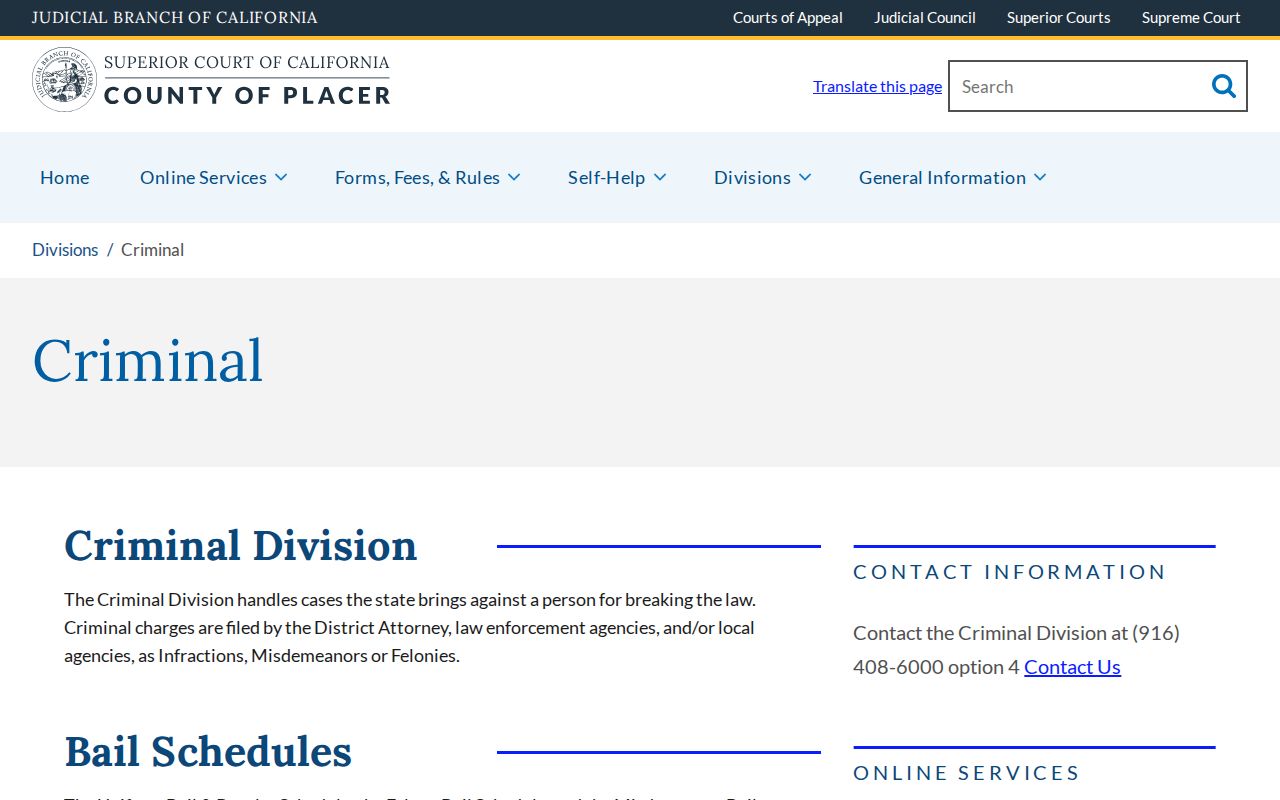
It links the case search to the division that maintains felony and misdemeanor files.
Get Placer Court Record Copies
Portal access is only one channel. The court says public documents may be viewed through the portal or by visiting the court. Its case records and copy request page explains the request path for copies, older material, and records that are not available remotely. A clerk name search taking more than ten minutes costs $15 per name. Copy charges follow the current court fee schedule.
The official copy-request instructions appear in this source image.
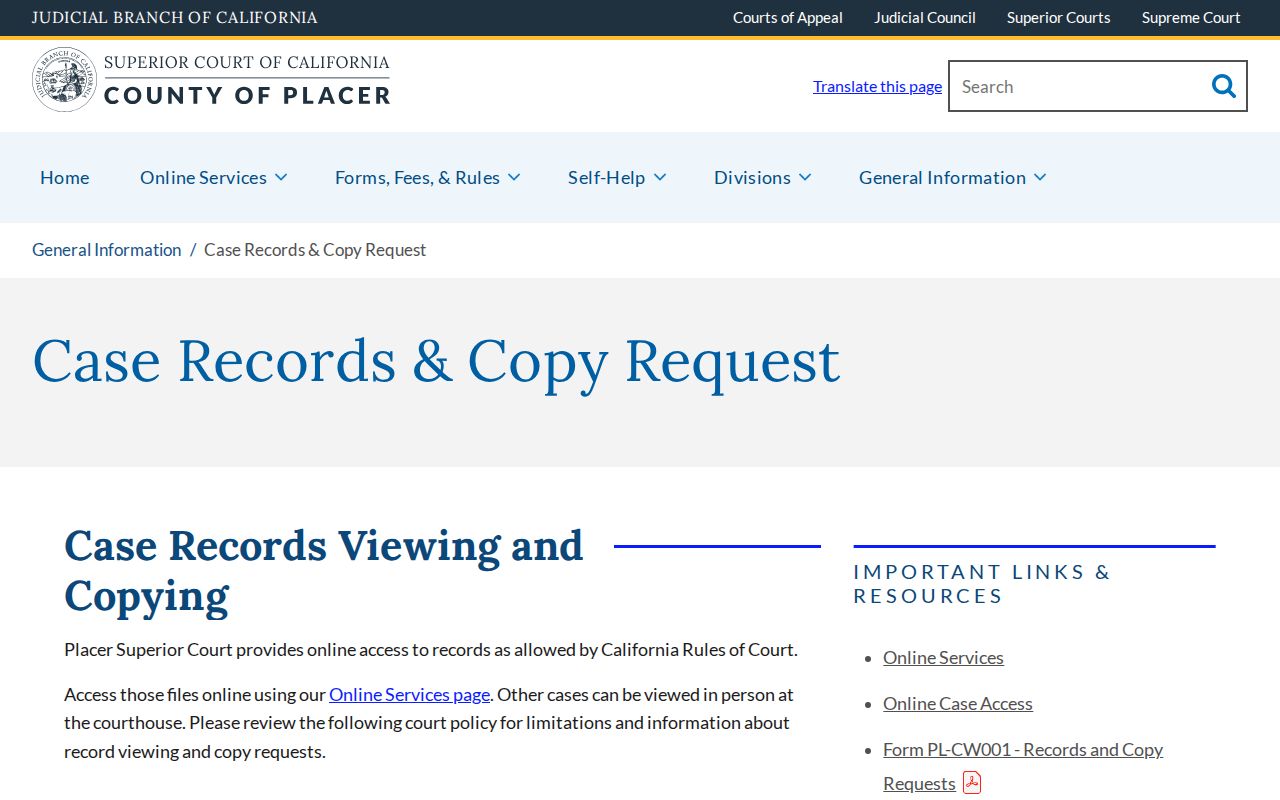
The request channel is the right next step when eCourt identifies a file but does not expose the needed public document.
Criminal Division
Hon. Howard G. Gibson Courthouse
10820 Justice Center Drive
Roseville, CA 95678
(916) 408-6000
Call first when the age, format, or restriction status of a Placer County court record is unclear. A precise case number, party name, and approximate filing year help staff locate the right file.
Placer Criminal Case Stages
A booking is not the first court stage. The District Attorney must make a charging decision, and the clerk opens a case only after filing. From that point, the public register may record this common path:
Charges Filed → Arraignment → Pretrial → Plea or Trial → Disposition → Sentencing
Arraignment is the first formal appearance for advisement and a plea. Pretrial entries can reflect motions, conferences, and scheduling. A disposition is the outcome of a count or case. Sentencing states the court's terms after a conviction. Cases vary, so a register may skip a trial after a plea, show a dismissal, or reflect later review.
The court's current fee and bail schedule page is shown in the source image below.
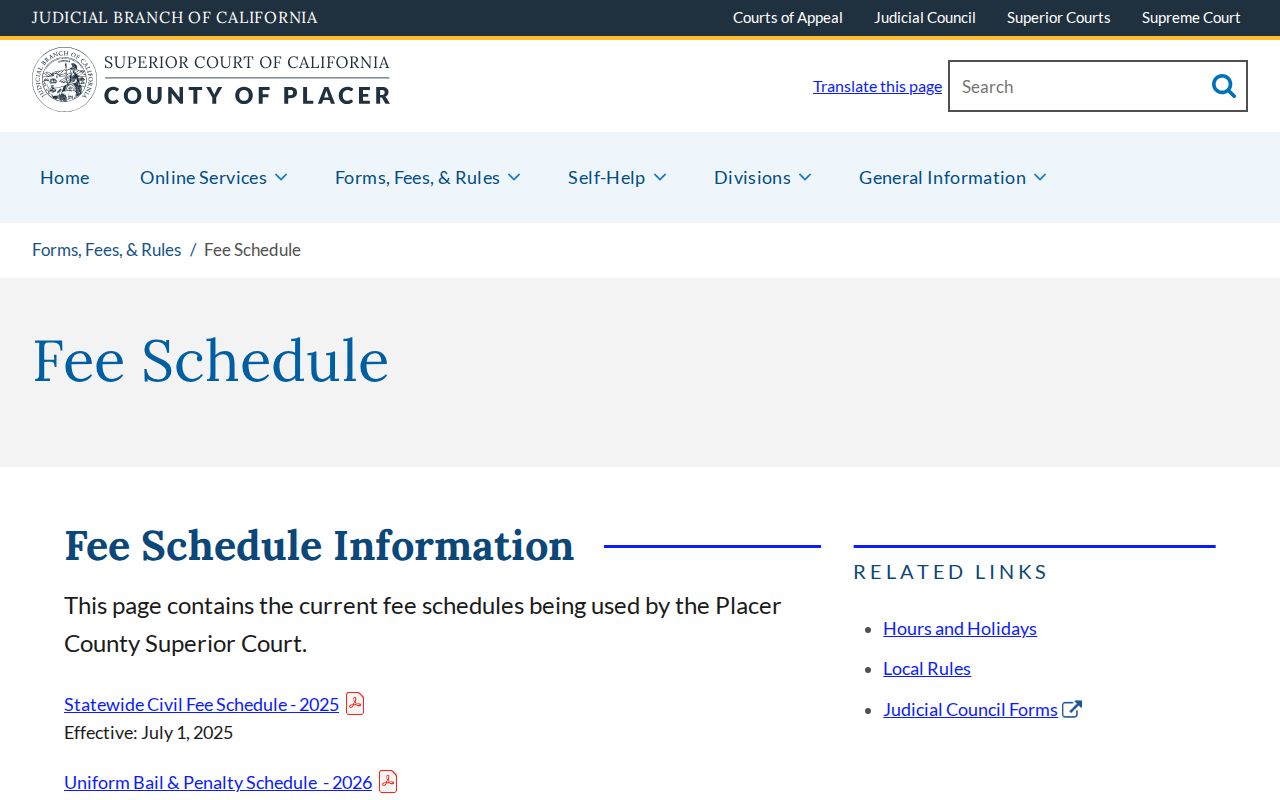
Consulting the current schedule avoids relying on an old copy price or bail amount.
Placer Criminal Court Locations
Different court buildings serve different parts of the Placer County court system. The official locations page identifies Roseville, Auburn, Tahoe City, and the jail courtroom. Department 20 at 11801 Go For Broke Road handles in-custody matters near South Placer Jail. The Historic Courthouse at 101 Maple Street preserves Auburn's role in a court system dating to 1851, while Tahoe City provides a North Lake location.
The court-location source is preserved in this Placer County criminal case image.
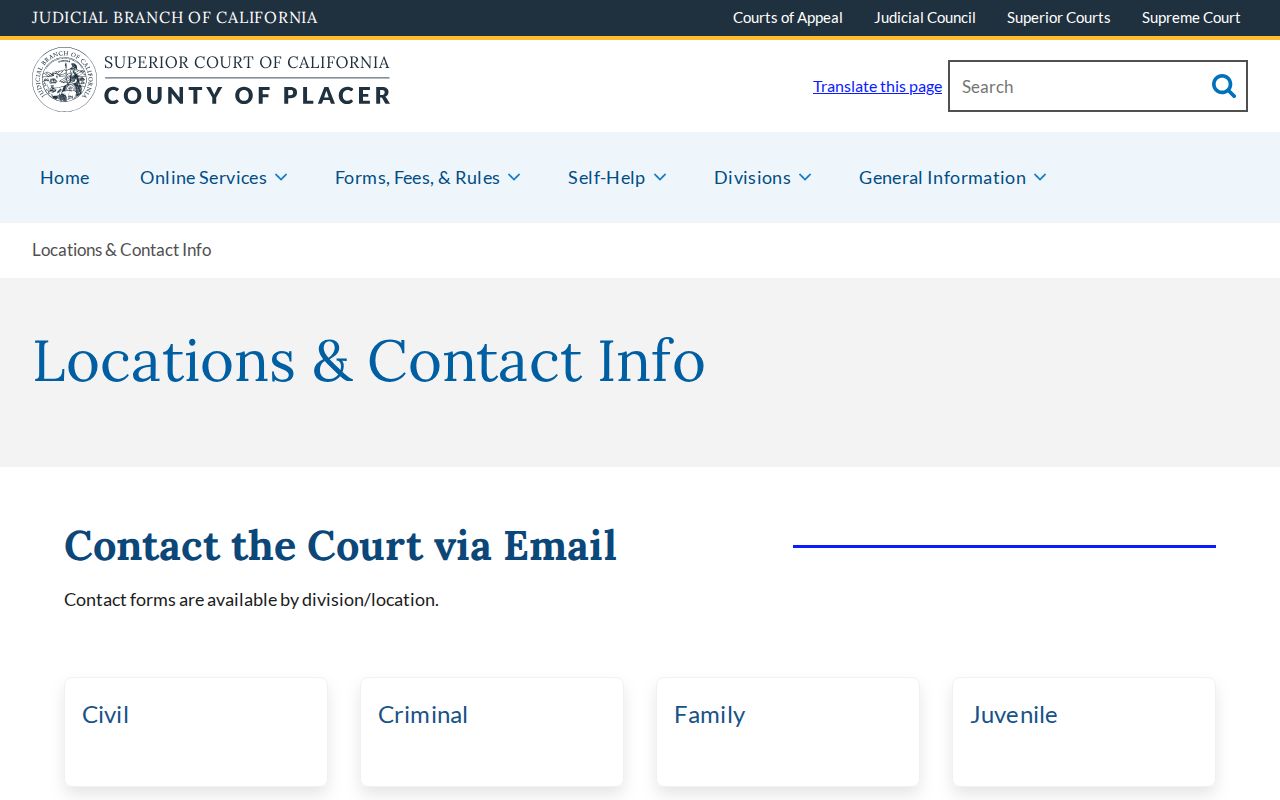
Confirm the location and department from the register or hearing notice before contacting a counter.
Placer Cases Are Not Rap Sheets
A court file records one filed action in Placer Superior Court. A California DOJ criminal history summary links fingerprint-based arrest cycles, charges, dispositions, and certain supervision entries from across the state. DOJ does not offer the public a name-based search for that product. An individual may request only their own record review through fingerprints.
| Source | What it answers | Public route |
|---|---|---|
| Placer eCourt | Was a public case filed here, and what happened on its docket? | Name or case-number search |
| Court copy | What does an available filing or order say? | Portal, counter, or copy request |
| California DOJ review | What is on the subject's statewide fingerprint record? | Subject-only Live Scan review |
Confusing these records can lead to a false conclusion. An arrest may never become a filed case, a court disposition may arrive later at DOJ, and a sealed or restricted matter may not appear to a remote user.
Placer Court Access Restrictions
California court records and executive-branch records follow different access rules. The California Public Records Act applies to county agencies, but judicial case access follows court rules and statutes. The California Judicial Branch access guide explains that some electronic records may be seen remotely while other material is available only at a courthouse.
Remote displays can omit protected identifiers and restricted case types. Juvenile files, sealed matters, confidential reports, and documents limited by law or court order are not made public merely because an index exists. A missing document icon also does not prove the paper is unavailable; it may call for courthouse inspection or a copy request.
Rule 2.507 governs electronic court calendars, indexes, and registers of actions. It does not turn every document in a Placer County criminal case into a remotely viewable record.
Note: Verify the final disposition in the originating Placer County court file before relying on a docket summary.